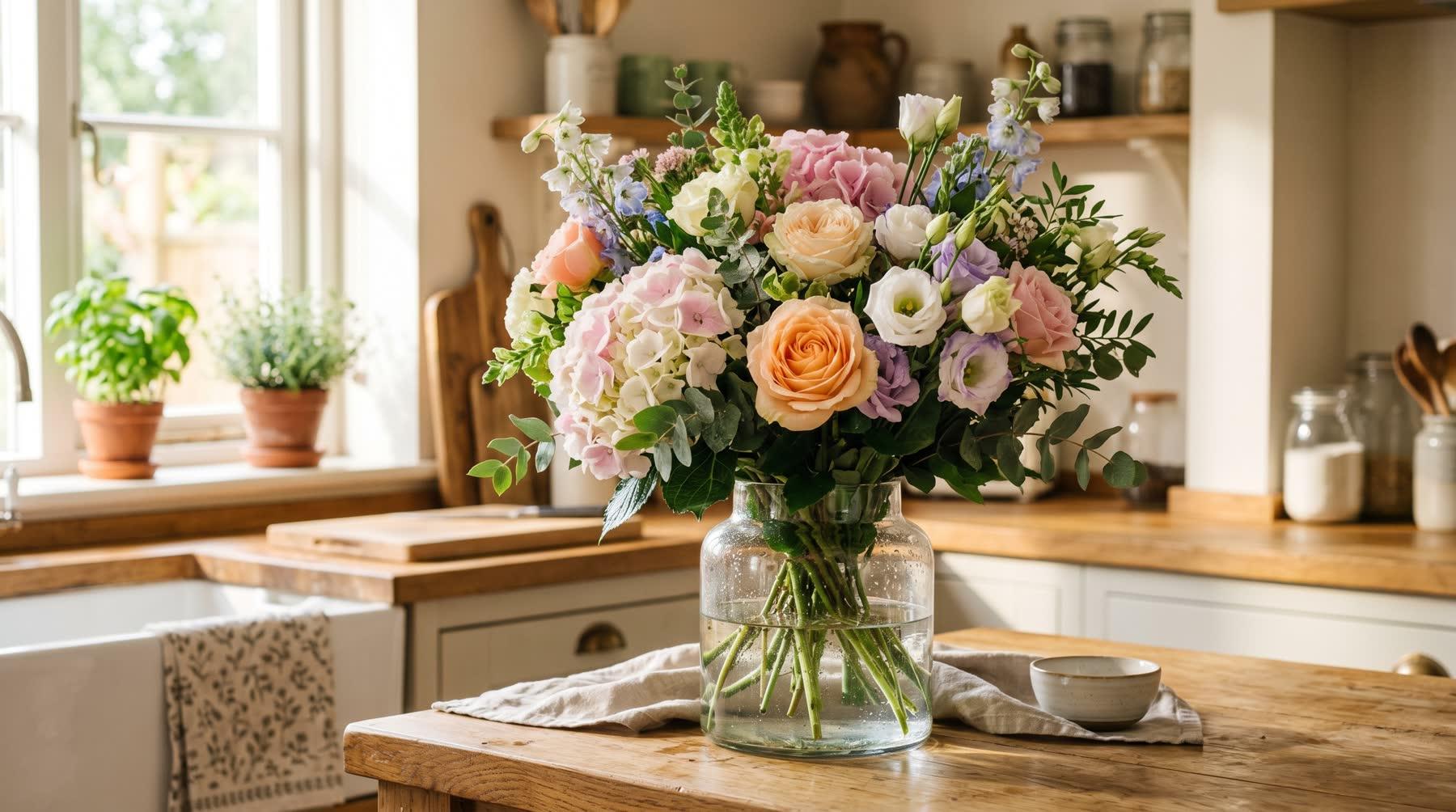
The fastest way to make cut flowers last longer is to re-cut the stems at a 45-degree angle every two to three days, change the water daily, and keep the vase out of direct sunlight. Do those three things in your Sedalia, MO home and most grocery-store bouquets will stretch from a sad five days to a solid 10 to 14. Florist-quality arrangements from our shop routinely hit two and a half weeks with the same routine.
We've been designing and delivering flowers across Sedalia and Pettis County for years, and the number one question we get after a delivery isn't about color or price. It's 'how do I keep these alive?' This bouquet care guide is the exact answer we give over the counter, adapted for Missouri's swing between dry winter furnace air and sticky July humidity.
Why Cut Flowers Die Faster Than They Should
Once a stem is cut, the flower is racing against three enemies: bacteria in the water, air bubbles clogging the stem, and dehydration from heat or moving air. Every fresh flower care tip worth knowing targets one of those three.
- Bacteria build up in vase water within 24 hours and block the stem from drinking
- Air embolisms form at the cut end the moment a stem leaves water, sealing it shut
- Heat, direct sun, and HVAC vents pull moisture out of petals faster than the stem can replace it
- Ethylene gas from ripening fruit speeds up wilting dramatically
Sedalia summers make problem number one worse. When our shop thermometer hits 90 degrees and the humidity pushes 70 percent, bacteria in untreated vase water double roughly every few hours. Winter flips the problem: forced-air heat in most Pettis County homes drops indoor humidity to 20 to 25 percent, which wicks water out of petals overnight.
Need flowers in Sedalia?
Tell us the occasion, delivery date, and style you have in mind. We'll help choose seasonal flowers that fit your budget.
The First 10 Minutes: What to Do the Moment Flowers Arrive
How you handle a bouquet in the first 10 minutes after delivery sets the ceiling for how long it will last. If you skip this, even the best flower food recipe can't save you.
- Unwrap the bouquet immediately and get the stems into water within 5 minutes
- Fill a clean vase with cool (not cold) tap water, roughly 60 to 70 degrees
- Add the flower food packet that came with the arrangement, or mix your own (recipe below)
- Strip any leaves that would sit below the waterline — submerged leaves rot and feed bacteria
- Re-cut each stem at a 45-degree angle, ideally under running water, removing the bottom 1 to 2 inches
- Place the vase somewhere cool and out of direct sun while you decide on a permanent spot
Pro Tip
The 45-degree cut isn't a florist superstition. A diagonal cut exposes more surface area for water uptake and prevents the stem from sitting flat against the vase bottom, which would seal it off. Use sharp kitchen shears or a paring knife, not dull scissors — crushed stems drink poorly.
Homemade Flower Food Recipe (When the Packet Runs Out)
Commercial flower food does three things: it feeds the stems sugar, lowers the water's pH so flowers drink more easily, and kills bacteria. You can replicate it with three things already in your Sedalia kitchen.
Mix per quart of lukewarm water: 2 teaspoons white sugar (the food), 2 teaspoons fresh lemon juice or apple cider vinegar (the pH adjuster), and a quarter teaspoon of plain household bleach (the bacteria killer). Stir until fully dissolved, then add your flowers.
- Sugar feeds the blooms the glucose they can no longer make through photosynthesis
- Lemon juice or vinegar drops pH to around 3.5, which helps water travel up the stem
- Bleach at this tiny concentration is safe for flowers and deadly to waterborne bacteria
- Refresh the solution every 2 to 3 days, not just the water
Pro Tip
Skip the old wives' tales. A penny in the vase does nothing (modern pennies are mostly zinc). Aspirin slightly lowers pH but has no antibacterial effect. Vodka works but only at concentrations that also damage delicate petals. The sugar-acid-bleach combo is what our design team uses in the back of the shop.
The Daily Routine That Doubles Vase Life
Cut flower care is not a one-time setup. The single biggest predictor of vase life, after the initial trim, is whether the owner bothers with a 60-second daily check. Here is the routine we recommend to every customer picking up a bouquet at our Sedalia shop.
- Day 1: Flowers arrive, stems trimmed, flower food added, vase placed in a cool spot
- Day 2: Top off water level, check for any drooping heads and remove any dropped petals
- Day 3: Dump old water, rinse the vase, re-cut stems, add fresh flower food solution
- Day 4-5: Top off water, remove any flowers that have clearly spent (they release ethylene)
- Day 6: Full water change, stem trim, flower food refresh
- Day 7+: Repeat the 3-day cycle — water change every 2 to 3 days is the sweet spot
When you pull spent blooms, don't toss the whole arrangement. Carnations, alstroemeria, and chrysanthemums often outlast roses and lilies by a week or more. Trim what's left, move everything to a smaller vase, and you get a bonus mini-arrangement.
Where to Put the Vase (and Where Not To)
Placement matters more than most people realize. We've had customers follow every other tip perfectly, then lose a bouquet in four days because they set it on top of the kitchen fruit bowl next to a sunny south window.
- Good: a cool hallway table, a dining room sideboard away from windows, a bedroom dresser
- Good: anywhere between 65 and 72 degrees with indirect light
- Bad: on top of a TV, fridge, or oven (heat-generating appliances)
- Bad: directly above a floor vent or under a ceiling fan running on high
- Bad: next to a bowl of bananas, apples, pears, or tomatoes (ethylene gas)
- Bad: a sunny windowsill, especially south or west-facing in a Missouri summer
Pro Tip
Pro florist move: if you want flowers to last through a weekend dinner party, refrigerate the arrangement overnight between events. Pull a shelf in your fridge, slide the vase in, and bring it back out an hour before guests arrive. This is how we hold wedding bouquets overnight before a Saturday ceremony at a Sedalia venue.
Missouri Climate Tips: Summer Heat and Winter Dryness
Sedalia weather is not kind to cut flowers. Missouri summers deliver heat indexes into the triple digits, and the humidity swings that come through Pettis County create rapid bacterial growth in vase water. Winter brings the opposite problem — dry indoor air that dehydrates petals in hours.
Here is how to adapt the standard care routine for each season in central Missouri.
- Summer (June-August): Change vase water every 2 days, not 3. Keep AC on a steady temperature rather than letting the house heat up during the day. Avoid placing flowers in sunrooms or enclosed porches
- Fall (September-November): Standard 3-day water change works fine. Watch for ethylene from decorative gourds and ripening apples — keep arrangements in a different room
- Winter (December-February): Mist petals lightly with water every other day to fight forced-air heat. Keep flowers away from fireplaces, space heaters, and register vents
- Spring (March-May): Tulips and other spring bulbs keep drinking and growing after being cut. Refresh water daily and expect the arrangement to reshape itself over a few days
Which Flowers Actually Last the Longest?
Even perfect care can only stretch a flower so far. Some varieties are built for the long haul, while others are glorious for four or five days and done. If longevity matters more than a specific look, bias your order toward the long-lasting list.
- Long vase life (10-14+ days): Carnations, chrysanthemums, alstroemeria, orchids, proteas, lisianthus
- Medium vase life (7-10 days): Roses, lilies, gerbera daisies, stock, snapdragons, sunflowers
- Short but stunning (4-7 days): Peonies, ranunculus, tulips, hydrangeas, dahlias, poppies
- Foliage and fillers (often outlast the flowers): Eucalyptus, ruscus, pittosporum, baby's breath
When a customer tells us they want flowers for a two-week stretch — say, a loved one recovering at Bothwell Regional Health Center — we lean heavily on alstroemeria, carnations, and lisianthus. For a one-night anniversary dinner, peonies and garden roses are worth the shorter life. The right pick depends on how long the arrangement needs to perform, which is something our designers talk through with every order.
Troubleshooting: Why Your Flowers Wilted Early
If a bouquet gave out before day seven, something in the chain broke. Walk back through this quick diagnostic before you blame the florist.
- Drooping heads on day 2-3: almost always an air embolism in the stem — re-cut under running water and the head usually perks back up within a few hours
- Cloudy or smelly water: bacterial bloom — dump, scrub the vase with dish soap, refill with flower food
- Petals browning at the edges: dehydration from heat or a draft — move to a cooler spot and mist lightly
- Whole arrangement collapsed overnight: usually ethylene exposure from nearby fruit, or the vase ran dry
- Only one type of flower died early: that variety may just be past its natural life — pull and regroup the rest
When to Order Fresh Instead
Even a well-tended bouquet hits a point where care can't save it. For anniversaries, sympathy deliveries, and hospital gifts across Sedalia, we recommend scheduling a fresh arrangement every 10 to 14 days rather than trying to nurse one bouquet for a month. Flowers are meant to be a fresh delight, not a project.
If you want flowers for Sedalia, Warrensburg, Knob Noster, Smithton, or Marshall, our team designs custom arrangements for pickup, delivery, weddings, events, and planned gifts. Stop by the shop, call us at (660) 206-2500, or order through our site.
Final Thoughts
Extending the vase life of flowers isn't complicated — it's consistent. Fresh water every 2 to 3 days, a clean cut at 45 degrees, flower food in the mix, and a cool spot away from heat and fruit. Follow that routine and your next bouquet from Sedalia Flowers will easily outlast the one before it.